
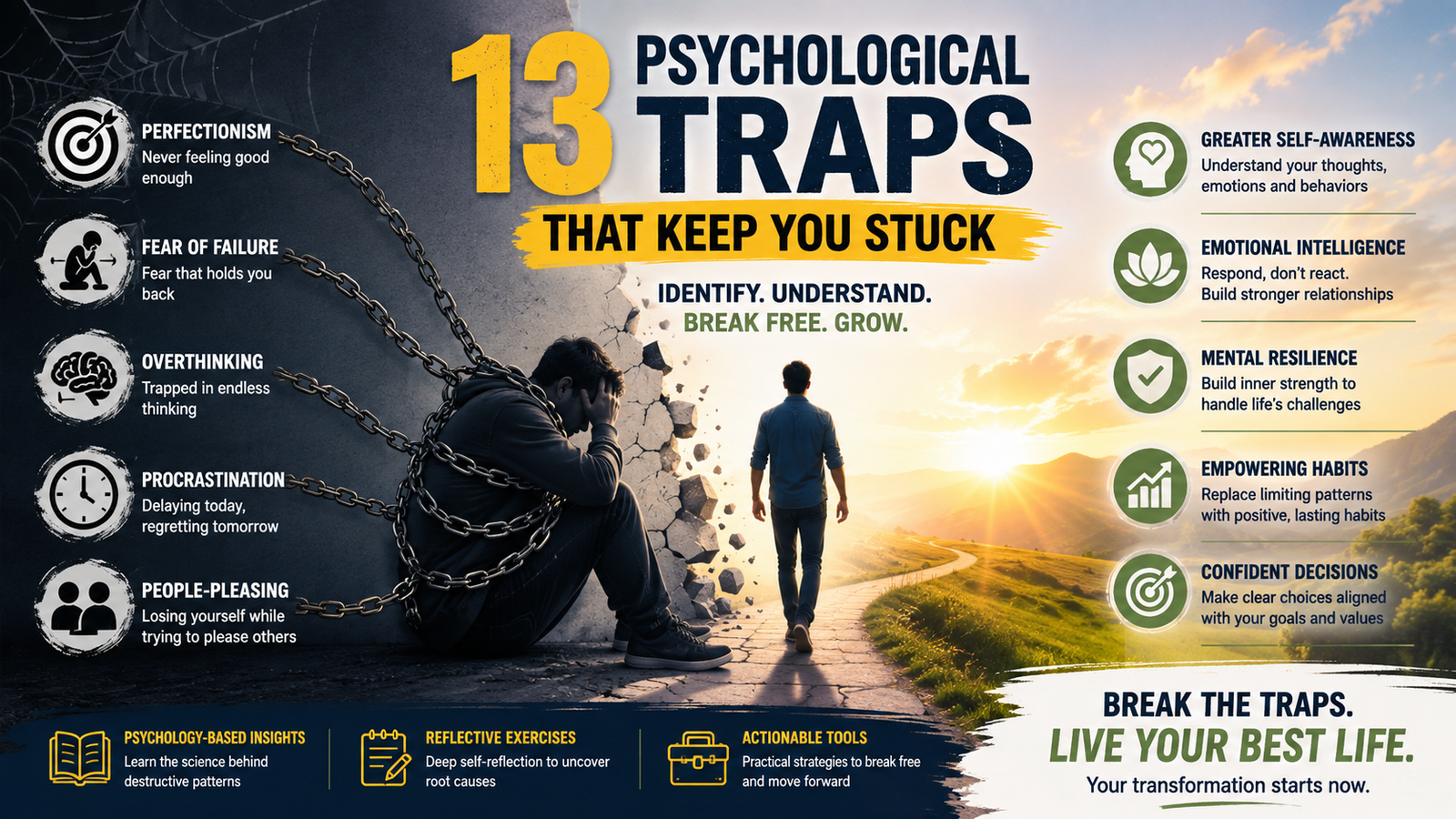
The course “13 Psychological Traps That Keep You Stuck” explores the hidden mental and emotional barriers that limit personal growth, happiness, and success. It helps learners identify destructive thought patterns such as perfectionism, fear of failure, overthinking, procrastination, and people-pleasing that keep them trapped in self-defeating cycles. Through psychology-based insights, reflective exercises, and actionable tools, learners will understand the root causes of these traps and how to replace them with empowering habits and beliefs.
By the end of this course, participants will develop greater emotional intelligence, self-awareness, and mental resilience. Designed for students, professionals, and anyone seeking personal development, this transformative learning journey equips learners with the mindset and strategies needed to overcome inner obstacles, make confident decisions, and achieve meaningful progress in both personal and professional life.
There are no formal entry requirements for the 13 Psychological Traps that Keep You Stuck course. It is open to anyone interested in personal growth, mindset transformation, or behavioural psychology. The course is ideal for students, professionals, and lifelong learners who wish to understand their own thinking patterns, overcome self-limiting beliefs, and build lasting emotional resilience.
Course Fee: £100
The course fee includes access to online learning materials, assessments, tutor support and the student learning portal.
Payment Options:
Please contact the admissions team for further information regarding payment arrangements.
The Multi-Tasking Trap
Explores how multitasking drains focus, reduces efficiency, and increases mistakes. Learners discover why switching tasks triggers cognitive overload and how to apply single-tasking techniques, focus batching, and attention-management methods to achieve higher productivity with less stress.
Decision Fatigue’s Hidden Cost
Reveals how making too many daily choices exhausts willpower and impairs judgement. Learners learn how to structure routines, automate small decisions, and reserve mental energy for priorities that matter most.
The Perfectionism Profit Killer
Examines how striving for flawlessness delays progress and fuels self-criticism. Learners identify perfectionistic tendencies and practise shifting from unrealistic standards to consistent, high-quality output and growth-oriented thinking.
Confirmation Bias Blinders
Shows how selective thinking limits learning and innovation. Learners develop skills to challenge assumptions, seek diverse perspectives, and make decisions based on balanced evidence.
Digital Distraction Tax
Focuses on the hidden productivity costs of constant connectivity. Learners explore attention hijacking, notification fatigue, and digital-detox strategies to reclaim focus and reduce cognitive fragmentation.
Sleep Deprivation’s Performance Collapse
Explains how poor sleep undermines decision-making, creativity, and emotional regulation. Learners understand sleep science, optimise routines, and adopt recovery habits for peak mental performance.
The Planning Fallacy Fail
Addresses why people consistently underestimate time and resources. Learners practise realistic planning, risk buffering, and reflective review to manage projects and deadlines effectively.
Sunk Cost Quicksand
Explores why people persist with failing plans due to invested time or resources. Learners develop detachment, objective evaluation, and strategic decision-making to cut losses wisely.
Cognitive Overload’s Breaking Point
Analyses the effects of excessive information processing. Learners learn to declutter mental space, prioritise effectively, and use structured frameworks for clearer thinking.
The Knowledge Illusion
Demonstrates how people overestimate what they know. Learners practise metacognition, questioning techniques, and continuous learning strategies to strengthen true understanding.
Emotional Reasoning’s Decision Hijack
Shows how emotions distort rational thought. Learners identify emotional triggers and apply emotional-intelligence strategies to make balanced, value-based decisions.
Reactivity’s Quality Cost
Examines impulsive reactions under pressure. Learners learn to pause, assess, and respond with intention, improving communication, leadership, and conflict management.
Understanding the Mental Bandwidth Myth
Reveals the limits of human attention and energy. Learners gain tools for managing bandwidth through focus cycles, rest, and strategic task design for sustainable performance.
Successful completion of the 13 Psychological Traps that Keep You Stuck course provides learners with strong foundations in emotional intelligence, behavioural awareness, and cognitive self-management. These skills enhance readiness for advanced studies in psychology, counselling, or personal development programmes. Learners can progress to related short courses or diploma-level qualifications focusing on mindset transformation, leadership psychology, or mental well-being.
The course “13 Psychological Traps That Keep You Stuck” explores the hidden mental and emotional barriers that limit personal growth, happiness, and success. It helps learners identify destructive thought patterns such as perfectionism, fear of failure, overthinking, procrastination, and people-pleasing that keep them trapped in self-defeating cycles. Through psychology-based insights, reflective exercises, and actionable tools, learners will understand the root causes of these traps and how to replace them with empowering habits and beliefs.
By the end of this course, participants will develop greater emotional intelligence, self-awareness, and mental resilience. Designed for students, professionals, and anyone seeking personal development, this transformative learning journey equips learners with the mindset and strategies needed to overcome inner obstacles, make confident decisions, and achieve meaningful progress in both personal and professional life.
There are no formal entry requirements for the 13 Psychological Traps that Keep You Stuck course. It is open to anyone interested in personal growth, mindset transformation, or behavioural psychology. The course is ideal for students, professionals, and lifelong learners who wish to understand their own thinking patterns, overcome self-limiting beliefs, and build lasting emotional resilience.
Course Fee: £100
The course fee includes access to online learning materials, assessments, tutor support and the student learning portal.
Payment Options:
Please contact the admissions team for further information regarding payment arrangements.
The Multi-Tasking Trap
Explores how multitasking drains focus, reduces efficiency, and increases mistakes. Learners discover why switching tasks triggers cognitive overload and how to apply single-tasking techniques, focus batching, and attention-management methods to achieve higher productivity with less stress.
Decision Fatigue’s Hidden Cost
Reveals how making too many daily choices exhausts willpower and impairs judgement. Learners learn how to structure routines, automate small decisions, and reserve mental energy for priorities that matter most.
The Perfectionism Profit Killer
Examines how striving for flawlessness delays progress and fuels self-criticism. Learners identify perfectionistic tendencies and practise shifting from unrealistic standards to consistent, high-quality output and growth-oriented thinking.
Confirmation Bias Blinders
Shows how selective thinking limits learning and innovation. Learners develop skills to challenge assumptions, seek diverse perspectives, and make decisions based on balanced evidence.
Digital Distraction Tax
Focuses on the hidden productivity costs of constant connectivity. Learners explore attention hijacking, notification fatigue, and digital-detox strategies to reclaim focus and reduce cognitive fragmentation.
Sleep Deprivation’s Performance Collapse
Explains how poor sleep undermines decision-making, creativity, and emotional regulation. Learners understand sleep science, optimise routines, and adopt recovery habits for peak mental performance.
The Planning Fallacy Fail
Addresses why people consistently underestimate time and resources. Learners practise realistic planning, risk buffering, and reflective review to manage projects and deadlines effectively.
Sunk Cost Quicksand
Explores why people persist with failing plans due to invested time or resources. Learners develop detachment, objective evaluation, and strategic decision-making to cut losses wisely.
Cognitive Overload’s Breaking Point
Analyses the effects of excessive information processing. Learners learn to declutter mental space, prioritise effectively, and use structured frameworks for clearer thinking.
The Knowledge Illusion
Demonstrates how people overestimate what they know. Learners practise metacognition, questioning techniques, and continuous learning strategies to strengthen true understanding.
Emotional Reasoning’s Decision Hijack
Shows how emotions distort rational thought. Learners identify emotional triggers and apply emotional-intelligence strategies to make balanced, value-based decisions.
Reactivity’s Quality Cost
Examines impulsive reactions under pressure. Learners learn to pause, assess, and respond with intention, improving communication, leadership, and conflict management.
Understanding the Mental Bandwidth Myth
Reveals the limits of human attention and energy. Learners gain tools for managing bandwidth through focus cycles, rest, and strategic task design for sustainable performance.
Successful completion of the 13 Psychological Traps that Keep You Stuck course provides learners with strong foundations in emotional intelligence, behavioural awareness, and cognitive self-management. These skills enhance readiness for advanced studies in psychology, counselling, or personal development programmes. Learners can progress to related short courses or diploma-level qualifications focusing on mindset transformation, leadership psychology, or mental well-being.

Want to receive push notifications for all major on-site activities?