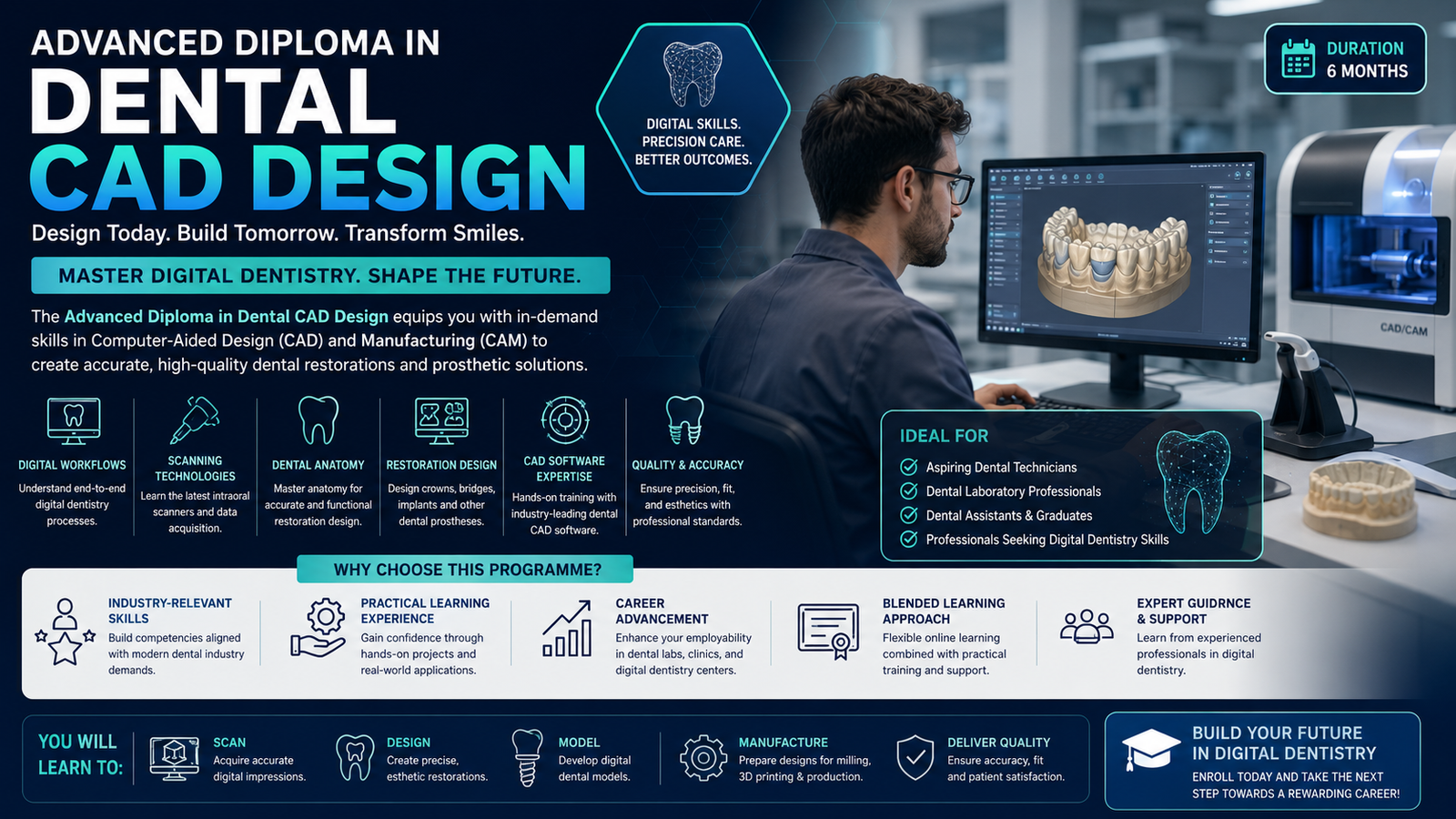
The Advanced Diploma in Dental CAD Design is a specialised six-month programme designed to develop the technical and practical skills required for modern digital dentistry. The course introduces learners to Computer-Aided Design (CAD) and Computer-Aided Manufacturing (CAM) technologies used in the design and production of dental restorations and prosthetic solutions.
Learners will explore digital dental workflows, scanning technologies, dental anatomy, restoration design, digital modelling, and the principles involved in designing crowns, bridges, implants, and other dental prostheses. Practical training enables participants to develop confidence in using industry-relevant dental CAD software while understanding accuracy, quality, and professional standards.
Applicants should have completed higher secondary education or an A-Level equivalent, preferably with a background in science subjects. Basic computer literacy and confidence in using common software applications are required, as the programme involves digital design technologies.
Previous experience in dental technology, dentistry, nursing, or healthcare-related roles is beneficial but not essential, making the course accessible to suitable beginners seeking specialist dental CAD skills.
Course Fee: £500
The course fee includes access to online learning materials, assessments, tutor support and the student learning portal.
Payment Options:
Please contact the admissions team for further information regarding payment arrangements.
Introduction to CAD
Introduces Computer-Aided Design and its applications in dental technology. Learners explore digital workflows, CAD/CAM systems, scanning technologies, design software and digital manufacturing processes.
Applied Oral Anatomy
Develops knowledge of tooth morphology, occlusion, dental arches, oral structures and functional relationships needed for accurate digital restoration design, appropriate aesthetics, functionality, fit and patient comfort.
Setting Principles
Explores tooth positioning and arrangement for dental prosthetic applications, including alignment, occlusal relationships, aesthetics, functional requirements and patient-specific considerations.
Measurements
Focuses on dimensions, proportions, spatial relationships, occlusal measurements and digital measurement tools. Learners examine how precision influences restoration fit, function, aesthetics and manufacturing quality.
Products
Introduces materials, products and restoration types used in digital dental technology, including crowns, bridges, dentures and implant-supported restorations, alongside product selection and CAD/CAM compatibility.
Carving and Applications
Develops understanding of dental morphology through practical carving and digital design. Learners practise tooth forms, contours, cusps, grooves, contact areas and functional surfaces and transfer these skills into CAD environments.
Successful completion of the Advanced Diploma in Dental CAD Design can support progression to higher-level studies in Dental Technology, Digital Dentistry, Dental Science, CAD/CAM Technology, or related healthcare disciplines.
Learners may pursue relevant undergraduate or specialist programmes, subject to individual university entry requirements. The diploma also strengthens technical skills for further professional development within digital dental laboratories and dentistry environments.
The Advanced Diploma in Dental CAD Design is a specialised six-month programme designed to develop the technical and practical skills required for modern digital dentistry. The course introduces learners to Computer-Aided Design (CAD) and Computer-Aided Manufacturing (CAM) technologies used in the design and production of dental restorations and prosthetic solutions.
Learners will explore digital dental workflows, scanning technologies, dental anatomy, restoration design, digital modelling, and the principles involved in designing crowns, bridges, implants, and other dental prostheses. Practical training enables participants to develop confidence in using industry-relevant dental CAD software while understanding accuracy, quality, and professional standards.
Applicants should have completed higher secondary education or an A-Level equivalent, preferably with a background in science subjects. Basic computer literacy and confidence in using common software applications are required, as the programme involves digital design technologies.
Previous experience in dental technology, dentistry, nursing, or healthcare-related roles is beneficial but not essential, making the course accessible to suitable beginners seeking specialist dental CAD skills.
Course Fee: £500
The course fee includes access to online learning materials, assessments, tutor support and the student learning portal.
Payment Options:
Please contact the admissions team for further information regarding payment arrangements.
Introduction to CAD
Introduces Computer-Aided Design and its applications in dental technology. Learners explore digital workflows, CAD/CAM systems, scanning technologies, design software and digital manufacturing processes.
Applied Oral Anatomy
Develops knowledge of tooth morphology, occlusion, dental arches, oral structures and functional relationships needed for accurate digital restoration design, appropriate aesthetics, functionality, fit and patient comfort.
Setting Principles
Explores tooth positioning and arrangement for dental prosthetic applications, including alignment, occlusal relationships, aesthetics, functional requirements and patient-specific considerations.
Measurements
Focuses on dimensions, proportions, spatial relationships, occlusal measurements and digital measurement tools. Learners examine how precision influences restoration fit, function, aesthetics and manufacturing quality.
Products
Introduces materials, products and restoration types used in digital dental technology, including crowns, bridges, dentures and implant-supported restorations, alongside product selection and CAD/CAM compatibility.
Carving and Applications
Develops understanding of dental morphology through practical carving and digital design. Learners practise tooth forms, contours, cusps, grooves, contact areas and functional surfaces and transfer these skills into CAD environments.
Successful completion of the Advanced Diploma in Dental CAD Design can support progression to higher-level studies in Dental Technology, Digital Dentistry, Dental Science, CAD/CAM Technology, or related healthcare disciplines.
Learners may pursue relevant undergraduate or specialist programmes, subject to individual university entry requirements. The diploma also strengthens technical skills for further professional development within digital dental laboratories and dentistry environments.
Want to receive push notifications for all major on-site activities?