
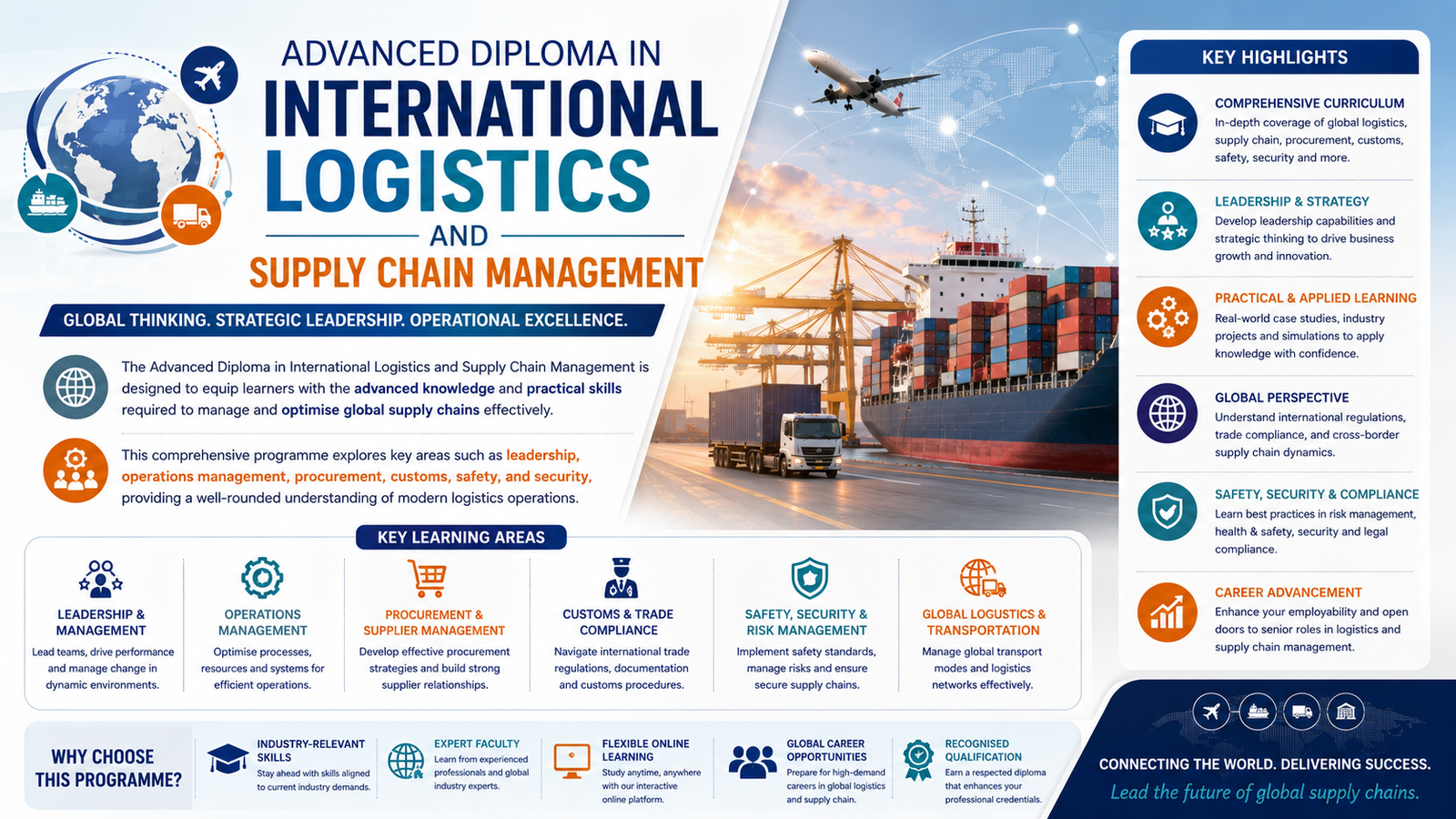
The Advanced Diploma in International Logistics and Supply Chain Management is designed to equip learners with the advanced knowledge and practical skills required to manage and optimise global supply chains effectively. This comprehensive programme explores key areas such as leadership, operations management, procurement, customs, safety, and security, providing a well-rounded understanding of modern logistics operations.
Learners will gain insights into strategic planning, risk management, and sustainable logistics, preparing them to handle the challenges of an increasingly interconnected and competitive global market. Emphasis is placed on real-world applications, critical thinking, and problem-solving to enhance professional competence and decision-making capabilities.
Whether you are already working in the logistics sector or aspiring to enter the field, this course provides the foundation and advanced expertise needed to progress into managerial and leadership roles across international logistics, supply chain, and global trade organisations.
Applicants should have completed higher secondary education (A-Level equivalent), preferably with a focus on business or related subjects. A basic understanding of logistics and supply chain principles is required. Relevant work experience in logistics or supply chain management is advantageous but not compulsory.
Course Fee: £500
The course fee includes access to online learning materials, assessments, tutor support and the student learning portal.
Payment Options:
Please contact the admissions team for further information regarding payment arrangements.
Leadership and Supervision in a Global Supply Chain Context
This module explores leadership roles and responsibilities within global supply chains, focusing on effective decision-making, team management, and strategic communication. Learners analyse different leadership styles, assess their impact on supply chain performance, and develop skills to lead diverse, cross-cultural teams. The module emphasises ethical leadership, collaboration, and adaptability in navigating complex international logistics environments.
Principles of Supply Chain Operations Management
This module focuses on supply chain operations management, enabling learners to analyse and apply its core principles for efficient, end-to-end processes. It examines the roles of key stakeholders and the growing influence of digital connectivity and technology, such as automation, data analytics, and real-time tracking, on improving collaboration, transparency, and overall performance within modern global supply chains.
Principles of Safety and Security in Logistics Operations
This module emphasises the importance of safety and security protocols in logistics operations, ensuring compliance with international standards and best practices. Learners will explore the principles of risk management, identifying, assessing, and mitigating potential threats within supply chains. Through practical case studies, they will develop strategies to maintain operational continuity, protect assets, and ensure safe, secure logistics environments.
Principles of Customs and International Freight
The module provides an in-depth understanding of customs regulations and their impact on international freight operations, highlighting compliance, documentation, and trade facilitation. Learners will also analyse the role of multi-modal transport systems—combining air, sea, rail, and road networks—in optimising efficiency, reducing costs, and enhancing connectivity within global supply chains to ensure smooth and timely movement of goods.
Principles of Inventory and Procurement Management
This module focuses on inventory management and procurement within global supply chains. Learners will understand and apply key inventory control techniques such as demand forecasting, stock optimisation, and just-in-time management. They will also analyse and implement strategic procurement practices, including supplier evaluation, contract negotiation, and cost management, to enhance efficiency, sustainability, and competitiveness in international supply chain operations.
Capstone Project in Supply Chain Operations
This capstone module enables learners to synthesise knowledge and skills acquired throughout the programme to address complex, real-world supply chain challenges. Through case studies, simulations, and problem-solving exercises, students will integrate concepts from logistics, procurement, leadership, and risk management to design innovative, efficient, and sustainable solutions that enhance performance across global supply chain networks.
Students of the Advanced Diploma in International Logistics and Supply Chain Management can progress to next degree programmes in logistics, supply chain management, international business, or operations management. This qualification also opens pathways to senior roles in global trade, procurement, and distribution, enabling learners to apply strategic, analytical, and leadership skills within international logistics and supply chain environments.
The Advanced Diploma in International Logistics and Supply Chain Management is designed to equip learners with the advanced knowledge and practical skills required to manage and optimise global supply chains effectively. This comprehensive programme explores key areas such as leadership, operations management, procurement, customs, safety, and security, providing a well-rounded understanding of modern logistics operations.
Learners will gain insights into strategic planning, risk management, and sustainable logistics, preparing them to handle the challenges of an increasingly interconnected and competitive global market. Emphasis is placed on real-world applications, critical thinking, and problem-solving to enhance professional competence and decision-making capabilities.
Whether you are already working in the logistics sector or aspiring to enter the field, this course provides the foundation and advanced expertise needed to progress into managerial and leadership roles across international logistics, supply chain, and global trade organisations.
Applicants should have completed higher secondary education (A-Level equivalent), preferably with a focus on business or related subjects. A basic understanding of logistics and supply chain principles is required. Relevant work experience in logistics or supply chain management is advantageous but not compulsory.
Course Fee: £500
The course fee includes access to online learning materials, assessments, tutor support and the student learning portal.
Payment Options:
Please contact the admissions team for further information regarding payment arrangements.
Leadership and Supervision in a Global Supply Chain Context
This module explores leadership roles and responsibilities within global supply chains, focusing on effective decision-making, team management, and strategic communication. Learners analyse different leadership styles, assess their impact on supply chain performance, and develop skills to lead diverse, cross-cultural teams. The module emphasises ethical leadership, collaboration, and adaptability in navigating complex international logistics environments.
Principles of Supply Chain Operations Management
This module focuses on supply chain operations management, enabling learners to analyse and apply its core principles for efficient, end-to-end processes. It examines the roles of key stakeholders and the growing influence of digital connectivity and technology, such as automation, data analytics, and real-time tracking, on improving collaboration, transparency, and overall performance within modern global supply chains.
Principles of Safety and Security in Logistics Operations
This module emphasises the importance of safety and security protocols in logistics operations, ensuring compliance with international standards and best practices. Learners will explore the principles of risk management, identifying, assessing, and mitigating potential threats within supply chains. Through practical case studies, they will develop strategies to maintain operational continuity, protect assets, and ensure safe, secure logistics environments.
Principles of Customs and International Freight
The module provides an in-depth understanding of customs regulations and their impact on international freight operations, highlighting compliance, documentation, and trade facilitation. Learners will also analyse the role of multi-modal transport systems—combining air, sea, rail, and road networks—in optimising efficiency, reducing costs, and enhancing connectivity within global supply chains to ensure smooth and timely movement of goods.
Principles of Inventory and Procurement Management
This module focuses on inventory management and procurement within global supply chains. Learners will understand and apply key inventory control techniques such as demand forecasting, stock optimisation, and just-in-time management. They will also analyse and implement strategic procurement practices, including supplier evaluation, contract negotiation, and cost management, to enhance efficiency, sustainability, and competitiveness in international supply chain operations.
Capstone Project in Supply Chain Operations
This capstone module enables learners to synthesise knowledge and skills acquired throughout the programme to address complex, real-world supply chain challenges. Through case studies, simulations, and problem-solving exercises, students will integrate concepts from logistics, procurement, leadership, and risk management to design innovative, efficient, and sustainable solutions that enhance performance across global supply chain networks.
Students of the Advanced Diploma in International Logistics and Supply Chain Management can progress to next degree programmes in logistics, supply chain management, international business, or operations management. This qualification also opens pathways to senior roles in global trade, procurement, and distribution, enabling learners to apply strategic, analytical, and leadership skills within international logistics and supply chain environments.
No related courses found.
Want to receive push notifications for all major on-site activities?