
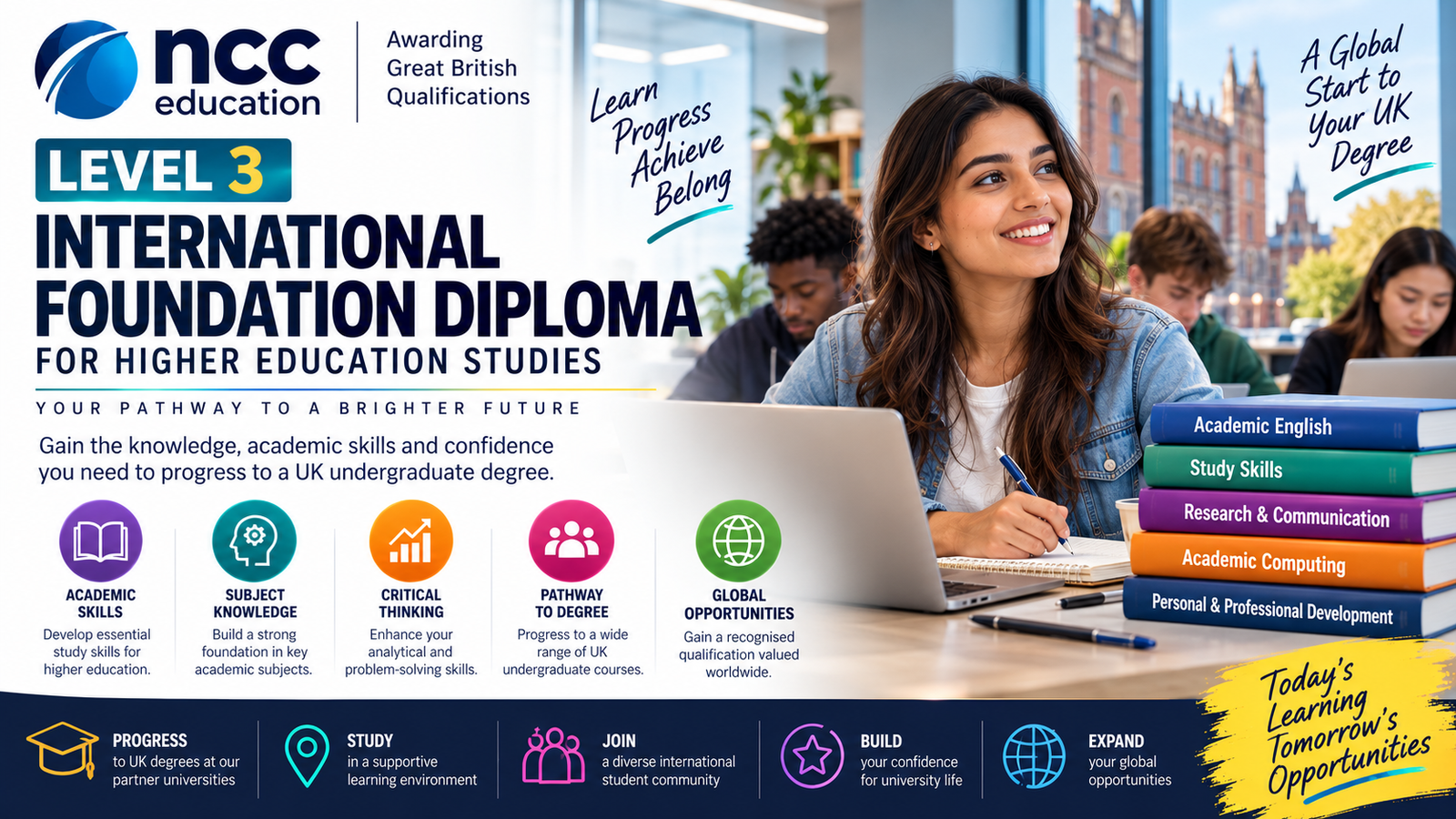
The NCC Education Level 3 International Foundation Diploma for Higher Education Studies (L3IFDHES) is a pre-university qualification designed to prepare learners for higher education programmes taught and assessed in English. It develops essential English language, mathematics, research and study skills while allowing learners to select subject-specific electives aligned with their intended university pathway.
The qualification is regulated by Ofqual and Qualifications Wales. It carries 120 credits, has a Total Qualification Time of 1,200 hours and 697 Guided Learning Hours. The programme offers pathways in areas including law, computer science, business, engineering, health sciences and higher finance, and is suitable for learners aged 16 to 19 as well as adult learners.
Applicants must normally have completed GCSE/IGCSE O Levels or an equivalent qualification in their own country and passed five subjects with minimum grades of C, 4 or equivalent in each. These subjects should include Mathematics and English.
For learners whose first language is not English, a valid IELTS score of 4.5 or above, or an accepted equivalent, is required. Alternatively, learners may take the NCC Education Standard English Placement Test administered by an Accredited Partner Centre. Centres must retain evidence supporting qualification and grade equivalency decisions for non-standard entry routes.
Course Fee: £4,500
The course fee includes access to online learning materials, assessments, tutor support and the student learning portal.
Payment Options:
Please contact the admissions team for further information regarding payment arrangements.
The qualification contains core units and a range of elective units. Learners must complete sufficient approved units to achieve the full 120-credit qualification. The exact combination depends on English language proficiency and the selected academic pathway.
Core Units
Developing English Language Skills (DELS 2.0)- 20 Credits
Develops general English communication at CEFR B2 level across speaking, reading, writing and listening. Learners strengthen grammar, vocabulary, fluency, comprehension and written communication so they can progress confidently into more demanding academic English study. This unit applies to learners entering with IELTS 4.5 to below 5.5.
English for Academic Purposes (EAP 2.0)- 30 Credits
Develops the academic English skills required for university-level study. Learners practise academic reading, listening, writing and speaking, including critical thinking, essay planning, interpretation of academic material and preparation for academic presentations and assessments.
Mathematics for University Study- 10 Credits
Builds the mathematical knowledge and problem-solving skills required for higher education. Learners study number, algebra, functions, graphs, geometry, trigonometry, probability, statistics and data presentation, applying mathematical reasoning to university-preparation contexts.
Research and Study Skills for University Study- 20 Credits
Develops the independent learning, research, note-taking, academic writing, referencing, presentation and examination skills needed for successful university study. Learners also plan research, evaluate sources and develop a structured research proposal.
Elective Units
Law for University Study- 20 Credits
Introduces the legal system of England and Wales, core legal concepts and methods of legal reasoning. Learners explore legal institutions, sources of law, case analysis, criminal law and the use of legal evidence and argument in academic assessments.
Introductory Accounting- 20 Credits
Provides a foundation in management and financial accounting. Learners explore business organisation, accounting information, costing, budgeting, financial statements, performance analysis and the role of accounting in business decision-making.
Introductory Economics- 20 Credits
Introduces core microeconomic and macroeconomic principles. Learners examine supply and demand, market behaviour, firms and consumers, national income, inflation, economic growth and the wider economic environment affecting business and society.
Introduction to Programming with Python- 20 Credits
Introduces programming concepts through Python. Learners develop computational thinking and practical coding skills using variables, selection, iteration, functions, data structures, testing and problem-solving to create and evaluate simple programmes.
International Business- 20 Credits
Explores the nature and scope of international business and the economic, cultural, political, legal and ethical factors that influence global activity. Learners examine business structures, finance, strategy, globalisation, international trade and approaches to entering overseas markets.
Physics for University Study- 20 Credits
Provides university-preparation knowledge in physics, including mechanics, kinematics, forces, energy, electricity, waves and modern physics. Learners apply mathematical methods and scientific reasoning to analyse physical systems and solve quantitative problems.
Further Mathematics for University Study- 20 Credits
Extends mathematical knowledge for learners progressing to mathematically demanding degrees. Topics include advanced algebra, functions, calculus, trigonometry, vectors, probability and other mathematical methods used in science, engineering and related disciplines.
Chemistry for University Study- 20 Credits
Develops foundational chemistry for higher education, covering atomic structure, bonding, energetics, kinetics, equilibria, organic chemistry and analytical techniques. Learners apply chemical principles to calculations, reactions and scientific problem-solving.
Biology for University Study- 20 Credits
Builds foundational knowledge for biological and health-related study. Learners explore cells, biological molecules, physiology, genetics, reproduction, immunity, ecology, biotechnology and the interpretation of biological evidence and processes.
Introduction to Computer Science- 10 Credits
Introduces the fundamental concepts that underpin computer science, including computer hardware, software, data, systems and computational principles. Learners develop an understanding of how computer systems operate and how computing concepts are applied in practice.
Digital World- 10 Credits
Explores how computing technology underpins modern society and the digital environment. Learners consider the development of digital computers, contemporary digital technologies, their impact on individuals and organisations, and the importance of cyber security.
The L3IFDHES is specifically designed as a university preparation qualification. NCC Education states that it prepares learners for direct entry into the first year of an undergraduate degree at internationally recognised universities, with pathways covering areas such as law, finance, accounting, economics, business, computer science, engineering and health sciences.
NCC Education reports more than 100 university progression routes in the UK and overseas. The qualification also provides a pathway to NCC Education Level 4 Diploma qualifications. Admission to a particular university or degree programme remains subject to the receiving institution’s current admissions requirements and recognition policies.

Want to receive push notifications for all major on-site activities?