
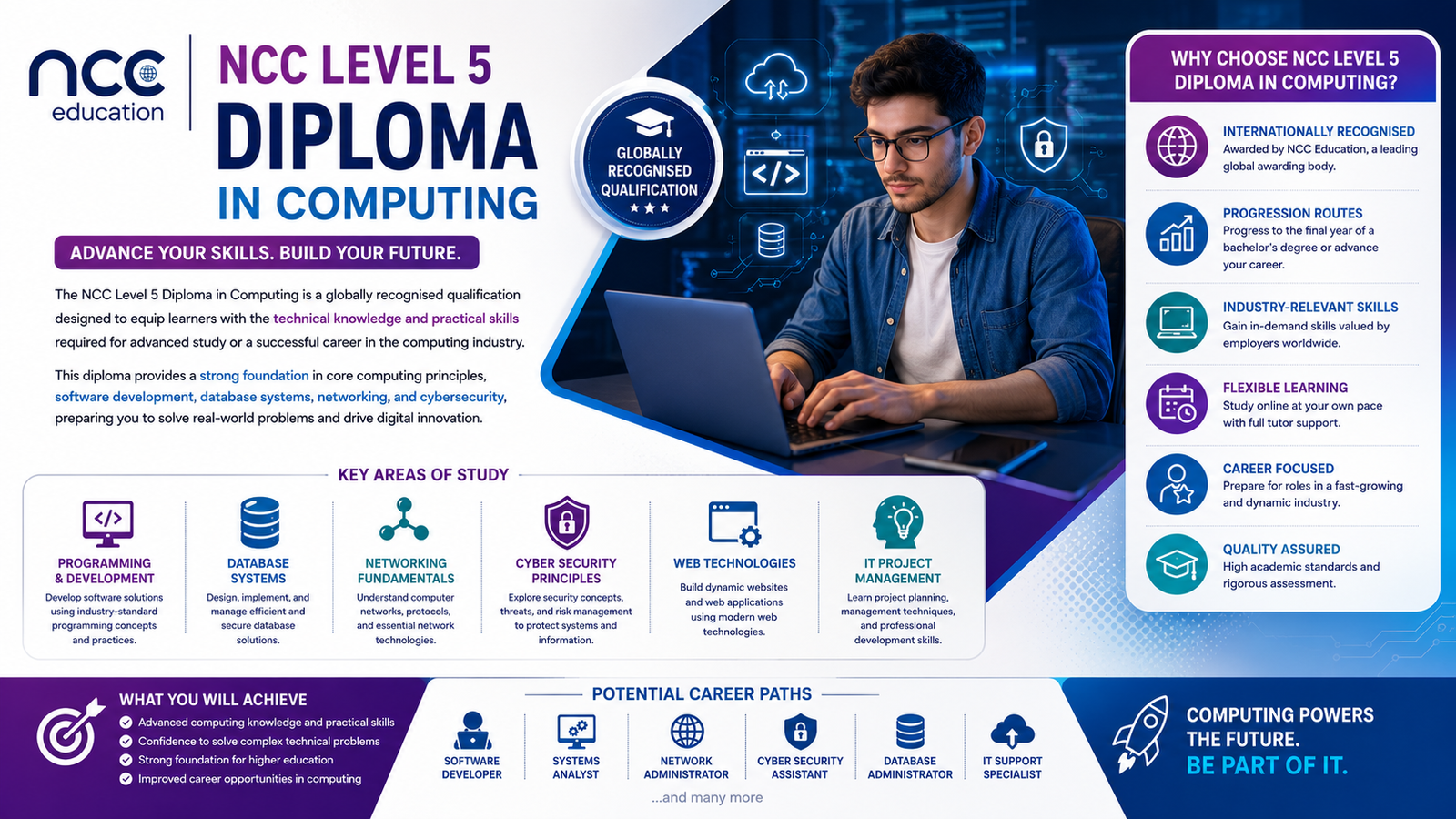
The NCC Education Level 5 Diploma in Computing (L5DC) is designed to build on the knowledge and skills developed at Level 4 and prepare learners to play a significant role within IT and computing organisations.
The programme introduces learners to current and in-demand areas of computing, including mobile application development, Agile development, network security and cryptography, computing projects, artificial intelligence, data science, data analysis, back-end web development and IT project management.
Applicants must have at least one of the following:
OR
Course Fee: £4,500
The course fee includes access to online learning materials, assessments, tutor support and the student learning portal.
Payment Options:
Please contact the admissions team for further information regarding payment arrangements.
Learners must successfully complete six units to achieve the NCC Education Level 5 Diploma in Computing.
The standard L5DC pathway consists of:
Core Units
Agile Development
This unit develops learners’ understanding of Agile approaches to software and systems development. Learners examine Agile principles, development lifecycles, team roles, techniques, documentation and methods such as timeboxing, and learn how to apply an appropriate Agile approach to a project scenario.
Mobile App Development
This unit develops the knowledge and practical skills required to understand, design and develop applications for mobile devices. Learners explore mobile application technologies, development processes, implementation, testing, version control and deployment of mobile applications.
Network Security and Cryptography
This unit develops a systematic understanding of network security and cryptography. Learners explore network security principles, cryptographic techniques, symmetric and asymmetric encryption, hash functions, digital signatures, operating system security, vulnerabilities and approaches to managing information security risks.
Computing Project
This unit enables learners to undertake a substantial computing project and develop an appropriate computing artefact. Learners identify a project, plan and manage its development, analyse requirements, design and construct the solution, test the outcome and critically evaluate both the project process and final result.
Elective Units
Learners select two of the following elective units to complete the qualification.
Analysis, Design and Implementation
This unit develops learners’ understanding of object-oriented analysis and design and the transition from analysing a system to developing an appropriate design. Learners explore modelling, prototyping, user-centred design and object-oriented approaches to implementing software solutions.
Artificial Intelligence
This unit introduces the principles, development and applications of artificial intelligence. Learners explore AI problem-solving, search methods, knowledge representation, uncertainty, machine learning concepts and AI applications before applying appropriate techniques to construct and evaluate AI models for real-world problems.
Back-End Web Development
This unit develops practical skills in server-side web development. Learners explore back-end technologies, programming languages, APIs and databases and learn how to design and develop dynamic web applications that communicate effectively between the back-end, database and user-facing interface.
Data Analysis and Visualisation with Python
This unit develops learners’ ability to use data science principles and Python to analyse and present data. Learners use tools such as Jupyter Notebook, develop Python programmes and apply data analysis and visualisation techniques to investigate information and address business problems.
Introduction to Data Science and Big Data
This unit introduces the fundamental concepts of data science, Big Data and data analytics. Learners examine different types and sources of data, data quality, the data science lifecycle, Big Data characteristics and the processes used to explore and analyse large and varied datasets.
Professional and Career Development in IT
This unit helps learners develop the professional and employability skills required for careers within the IT sector. Learners evaluate their existing skills, identify development needs, consider career opportunities and develop professional materials and plans that support their future career progression.
IT Project Management
This unit develops learners’ understanding of how IT projects are planned, organised, monitored and controlled. Learners examine project lifecycles, planning techniques, estimating, risk, resources, monitoring and control, change management and the challenges associated with managing technology projects.
The NCC Level 5 Diploma in Computing makes up the second year of the NCC Education degree journey and builds upon the knowledge developed through the Level 4 Diploma in Computing. NCC Education qualifications are recognised and valued by employers and universities worldwide.
The qualification therefore provides a higher education pathway for learners wishing to continue their computing studies beyond Level 5.
The NCC Education Level 5 Diploma in Computing (L5DC) is designed to build on the knowledge and skills developed at Level 4 and prepare learners to play a significant role within IT and computing organisations.
The programme introduces learners to current and in-demand areas of computing, including mobile application development, Agile development, network security and cryptography, computing projects, artificial intelligence, data science, data analysis, back-end web development and IT project management.
Applicants must have at least one of the following:
OR
Course Fee: £4,500
The course fee includes access to online learning materials, assessments, tutor support and the student learning portal.
Payment Options:
Please contact the admissions team for further information regarding payment arrangements.
Learners must successfully complete six units to achieve the NCC Education Level 5 Diploma in Computing.
The standard L5DC pathway consists of:
Core Units
Agile Development
This unit develops learners’ understanding of Agile approaches to software and systems development. Learners examine Agile principles, development lifecycles, team roles, techniques, documentation and methods such as timeboxing, and learn how to apply an appropriate Agile approach to a project scenario.
Mobile App Development
This unit develops the knowledge and practical skills required to understand, design and develop applications for mobile devices. Learners explore mobile application technologies, development processes, implementation, testing, version control and deployment of mobile applications.
Network Security and Cryptography
This unit develops a systematic understanding of network security and cryptography. Learners explore network security principles, cryptographic techniques, symmetric and asymmetric encryption, hash functions, digital signatures, operating system security, vulnerabilities and approaches to managing information security risks.
Computing Project
This unit enables learners to undertake a substantial computing project and develop an appropriate computing artefact. Learners identify a project, plan and manage its development, analyse requirements, design and construct the solution, test the outcome and critically evaluate both the project process and final result.
Elective Units
Learners select two of the following elective units to complete the qualification.
Analysis, Design and Implementation
This unit develops learners’ understanding of object-oriented analysis and design and the transition from analysing a system to developing an appropriate design. Learners explore modelling, prototyping, user-centred design and object-oriented approaches to implementing software solutions.
Artificial Intelligence
This unit introduces the principles, development and applications of artificial intelligence. Learners explore AI problem-solving, search methods, knowledge representation, uncertainty, machine learning concepts and AI applications before applying appropriate techniques to construct and evaluate AI models for real-world problems.
Back-End Web Development
This unit develops practical skills in server-side web development. Learners explore back-end technologies, programming languages, APIs and databases and learn how to design and develop dynamic web applications that communicate effectively between the back-end, database and user-facing interface.
Data Analysis and Visualisation with Python
This unit develops learners’ ability to use data science principles and Python to analyse and present data. Learners use tools such as Jupyter Notebook, develop Python programmes and apply data analysis and visualisation techniques to investigate information and address business problems.
Introduction to Data Science and Big Data
This unit introduces the fundamental concepts of data science, Big Data and data analytics. Learners examine different types and sources of data, data quality, the data science lifecycle, Big Data characteristics and the processes used to explore and analyse large and varied datasets.
Professional and Career Development in IT
This unit helps learners develop the professional and employability skills required for careers within the IT sector. Learners evaluate their existing skills, identify development needs, consider career opportunities and develop professional materials and plans that support their future career progression.
IT Project Management
This unit develops learners’ understanding of how IT projects are planned, organised, monitored and controlled. Learners examine project lifecycles, planning techniques, estimating, risk, resources, monitoring and control, change management and the challenges associated with managing technology projects.
The NCC Level 5 Diploma in Computing makes up the second year of the NCC Education degree journey and builds upon the knowledge developed through the Level 4 Diploma in Computing. NCC Education qualifications are recognised and valued by employers and universities worldwide.
The qualification therefore provides a higher education pathway for learners wishing to continue their computing studies beyond Level 5.
No related courses found.
Want to receive push notifications for all major on-site activities?