
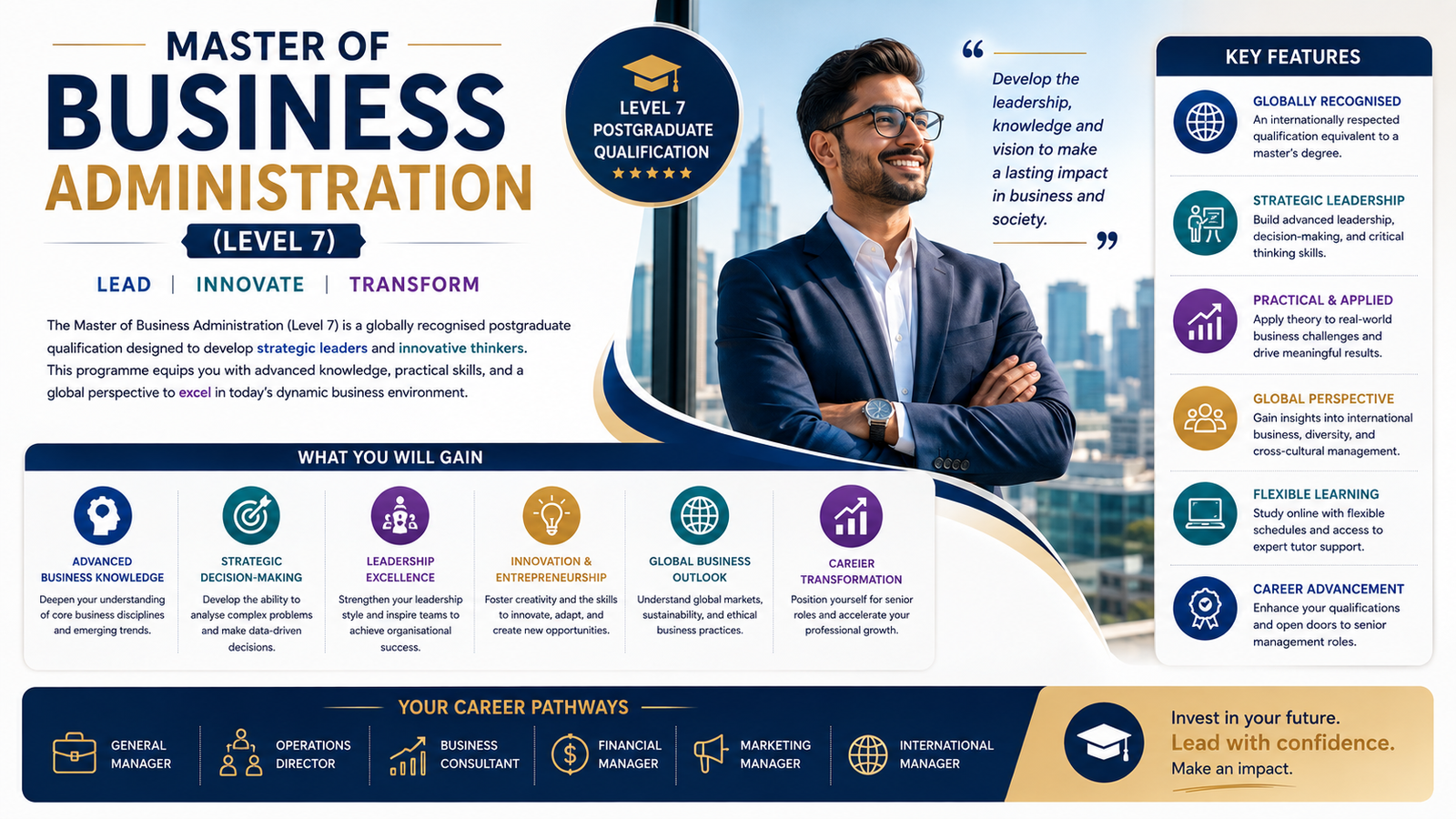
The Master of Business Administration (Level 7) is an advanced postgraduate qualification designed to develop the strategic leadership, management, and decision-making capabilities required to succeed in today’s dynamic and competitive global business environment. The programme provides learners with a comprehensive understanding of key business disciplines, including strategic management, finance, marketing, human resource management, operations management, entrepreneurship, and organisational leadership.
Through practical case studies, applied learning, research activities, and industry-focused assignments, students develop advanced analytical, critical-thinking, problem-solving, and decision-making skills. The programme encourages learners to evaluate complex business situations, develop effective strategies, manage organisational resources, and respond confidently to emerging opportunities and challenges.
With a strong emphasis on innovation, ethical leadership, sustainable business practices, and international perspectives, the qualification prepares graduates to operate effectively across diverse organisational and cultural environments. Successful completion provides a strong foundation for progression into senior management and leadership positions, entrepreneurial ventures, consultancy, or further academic study, while equipping learners with the knowledge and professional capabilities to create sustainable value in organisations worldwide.
Applicants are normally expected to hold a bachelor’s degree or equivalent Level 6 qualification in business, management, or another relevant discipline. Applicants with qualifications in other subject areas may also be considered where appropriate. Relevant managerial or professional experience can strengthen an application. Learners must also demonstrate sufficient English language proficiency to undertake postgraduate-level study. Specific requirements may vary according to the awarding university or institution.
Course Fee: £6000
The course fee includes access to online learning materials, assessments, tutor support and the student learning portal.
Payment Options:
Please contact the admissions team for further information regarding payment arrangements.
Strategic Human Resource Management
This module explores how human resource strategies contribute to organisational performance and long-term objectives. Learners examine workforce planning, talent management, recruitment, employee engagement, performance management, and organisational culture. The module develops the ability to align people-management practices with business strategy while considering changing workforce expectations, employment practices, leadership priorities, and the importance of developing and retaining organisational talent.
Strategic Leadership and Management
This module develops an understanding of leadership and management at a strategic level. Learners examine leadership styles, organisational vision, strategic decision-making, change management, stakeholder relationships, and performance improvement. The module encourages critical evaluation of leadership approaches and develops the skills required to lead teams, manage complex organisational challenges, communicate strategic priorities, and contribute effectively to sustainable organisational success.
Supply Chain Planning, Modelling and Analytics
This module examines how organisations plan, analyse, and optimise supply chain activities. Learners explore demand forecasting, inventory management, logistics, capacity planning, supply chain modelling, and performance measurement. Analytical techniques are applied to support evidence-based decisions, identify inefficiencies, manage uncertainty, and improve operational performance while considering resilience, sustainability, customer expectations, and the increasingly data-driven nature of global supply chains.
Accounting and Financial Management
This module develops learners’ understanding of accounting and financial information used to support business decision-making. Topics include financial statements, budgeting, costing, cash flow, financial analysis, investment decisions, and performance evaluation. Learners develop the ability to interpret financial information, assess organisational performance, allocate resources effectively, and contribute to informed strategic decisions that support financial sustainability and organisational objectives.
Entrepreneurship and Innovation
This module explores the principles of entrepreneurship and the role of innovation in creating and developing successful organisations. Learners examine opportunity identification, business models, entrepreneurial thinking, creativity, risk, financing, and commercialisation. The module develops the ability to evaluate innovative ideas, respond to changing markets, and formulate strategies for launching or growing ventures while creating sustainable economic and customer value.
Consumer Behaviour and Market Communications
This module examines how consumers make purchasing decisions and how organisations communicate effectively with their target markets. Learners explore psychological, social, cultural, and economic influences on consumer behaviour alongside segmentation and customer decision-making. The module also considers integrated marketing communications, branding, digital channels, advertising, and promotional strategies, enabling learners to develop communications that effectively engage defined audiences.
Contemporary Issues and Principles of Marketing
This module combines fundamental marketing principles with an examination of contemporary developments affecting organisations and consumers. Learners explore market analysis, segmentation, targeting, positioning, marketing strategy, digital transformation, sustainability, technology, and changing customer expectations. The module develops critical awareness of how businesses adapt marketing practices to emerging trends while creating customer value, maintaining competitiveness, and responding responsibly to evolving markets.
Business Research Project
This module enables learners to undertake an independent research project addressing a relevant business or management issue. Learners formulate research questions, review literature, select appropriate methodologies, collect and analyse evidence, and present findings and recommendations. The project develops research, critical thinking, problem-solving, academic writing, and project management skills while encouraging learners to apply theoretical knowledge to a practical business context.
Successful completion of the Master of Business Administration (Level 7) can support progression to advanced postgraduate study, including Doctor of Business Administration (DBA), PhD in Business or Management, and other doctoral-level programmes. Graduates may also pursue specialist postgraduate qualifications in leadership, finance, marketing, entrepreneurship, or strategic management, subject to the admission requirements of the chosen university or institution.
The Master of Business Administration (Level 7) is an advanced postgraduate qualification designed to develop the strategic leadership, management, and decision-making capabilities required to succeed in today’s dynamic and competitive global business environment. The programme provides learners with a comprehensive understanding of key business disciplines, including strategic management, finance, marketing, human resource management, operations management, entrepreneurship, and organisational leadership.
Through practical case studies, applied learning, research activities, and industry-focused assignments, students develop advanced analytical, critical-thinking, problem-solving, and decision-making skills. The programme encourages learners to evaluate complex business situations, develop effective strategies, manage organisational resources, and respond confidently to emerging opportunities and challenges.
With a strong emphasis on innovation, ethical leadership, sustainable business practices, and international perspectives, the qualification prepares graduates to operate effectively across diverse organisational and cultural environments. Successful completion provides a strong foundation for progression into senior management and leadership positions, entrepreneurial ventures, consultancy, or further academic study, while equipping learners with the knowledge and professional capabilities to create sustainable value in organisations worldwide.
Applicants are normally expected to hold a bachelor’s degree or equivalent Level 6 qualification in business, management, or another relevant discipline. Applicants with qualifications in other subject areas may also be considered where appropriate. Relevant managerial or professional experience can strengthen an application. Learners must also demonstrate sufficient English language proficiency to undertake postgraduate-level study. Specific requirements may vary according to the awarding university or institution.
Course Fee: £6000
The course fee includes access to online learning materials, assessments, tutor support and the student learning portal.
Payment Options:
Please contact the admissions team for further information regarding payment arrangements.
Strategic Human Resource Management
This module explores how human resource strategies contribute to organisational performance and long-term objectives. Learners examine workforce planning, talent management, recruitment, employee engagement, performance management, and organisational culture. The module develops the ability to align people-management practices with business strategy while considering changing workforce expectations, employment practices, leadership priorities, and the importance of developing and retaining organisational talent.
Strategic Leadership and Management
This module develops an understanding of leadership and management at a strategic level. Learners examine leadership styles, organisational vision, strategic decision-making, change management, stakeholder relationships, and performance improvement. The module encourages critical evaluation of leadership approaches and develops the skills required to lead teams, manage complex organisational challenges, communicate strategic priorities, and contribute effectively to sustainable organisational success.
Supply Chain Planning, Modelling and Analytics
This module examines how organisations plan, analyse, and optimise supply chain activities. Learners explore demand forecasting, inventory management, logistics, capacity planning, supply chain modelling, and performance measurement. Analytical techniques are applied to support evidence-based decisions, identify inefficiencies, manage uncertainty, and improve operational performance while considering resilience, sustainability, customer expectations, and the increasingly data-driven nature of global supply chains.
Accounting and Financial Management
This module develops learners’ understanding of accounting and financial information used to support business decision-making. Topics include financial statements, budgeting, costing, cash flow, financial analysis, investment decisions, and performance evaluation. Learners develop the ability to interpret financial information, assess organisational performance, allocate resources effectively, and contribute to informed strategic decisions that support financial sustainability and organisational objectives.
Entrepreneurship and Innovation
This module explores the principles of entrepreneurship and the role of innovation in creating and developing successful organisations. Learners examine opportunity identification, business models, entrepreneurial thinking, creativity, risk, financing, and commercialisation. The module develops the ability to evaluate innovative ideas, respond to changing markets, and formulate strategies for launching or growing ventures while creating sustainable economic and customer value.
Consumer Behaviour and Market Communications
This module examines how consumers make purchasing decisions and how organisations communicate effectively with their target markets. Learners explore psychological, social, cultural, and economic influences on consumer behaviour alongside segmentation and customer decision-making. The module also considers integrated marketing communications, branding, digital channels, advertising, and promotional strategies, enabling learners to develop communications that effectively engage defined audiences.
Contemporary Issues and Principles of Marketing
This module combines fundamental marketing principles with an examination of contemporary developments affecting organisations and consumers. Learners explore market analysis, segmentation, targeting, positioning, marketing strategy, digital transformation, sustainability, technology, and changing customer expectations. The module develops critical awareness of how businesses adapt marketing practices to emerging trends while creating customer value, maintaining competitiveness, and responding responsibly to evolving markets.
Business Research Project
This module enables learners to undertake an independent research project addressing a relevant business or management issue. Learners formulate research questions, review literature, select appropriate methodologies, collect and analyse evidence, and present findings and recommendations. The project develops research, critical thinking, problem-solving, academic writing, and project management skills while encouraging learners to apply theoretical knowledge to a practical business context.
Successful completion of the Master of Business Administration (Level 7) can support progression to advanced postgraduate study, including Doctor of Business Administration (DBA), PhD in Business or Management, and other doctoral-level programmes. Graduates may also pursue specialist postgraduate qualifications in leadership, finance, marketing, entrepreneurship, or strategic management, subject to the admission requirements of the chosen university or institution.


Want to receive push notifications for all major on-site activities?