
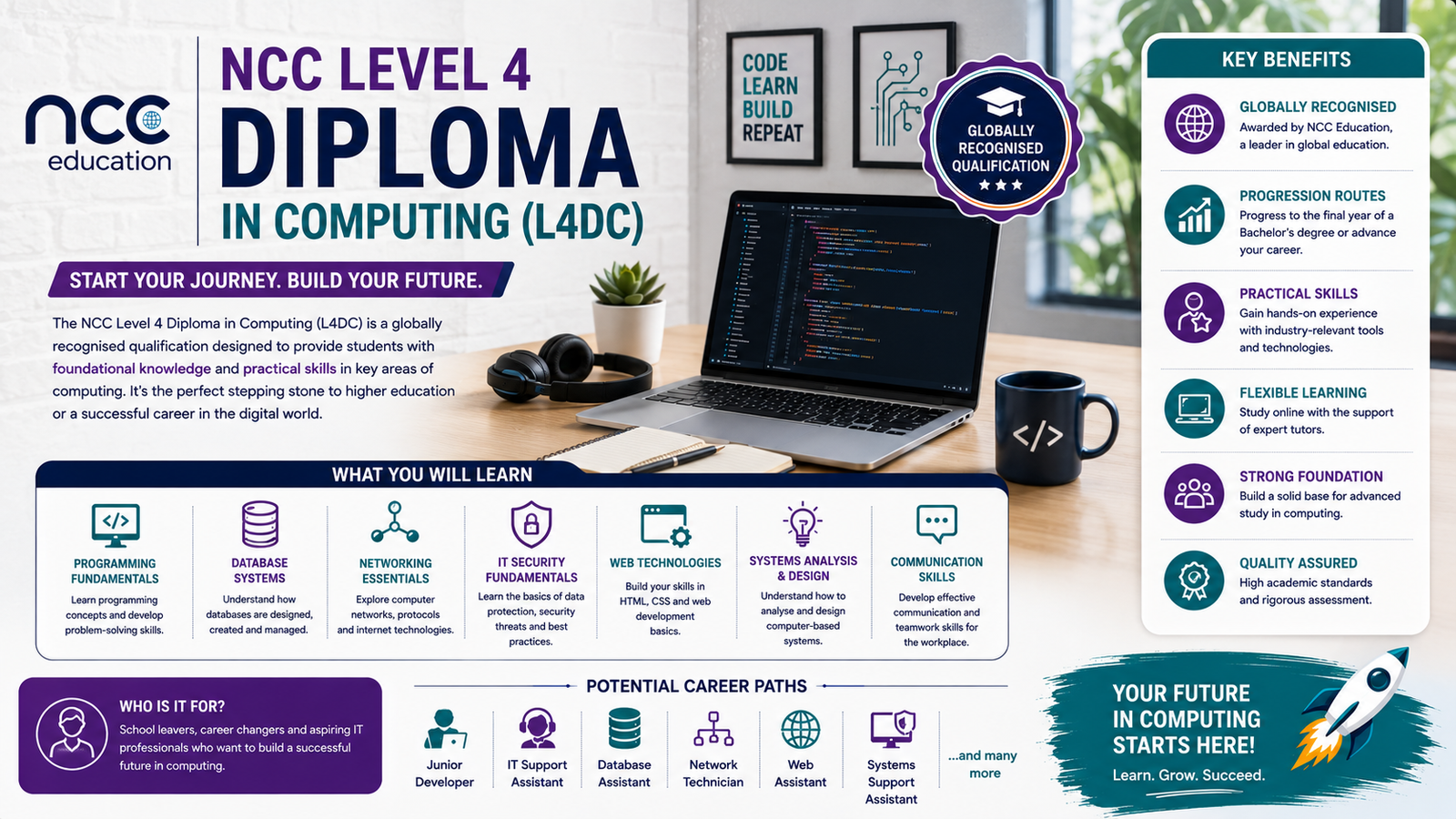
The NCC Education Level 4 Diploma in Computing (L4DC) is designed to provide learners with a broad understanding of computing and develop the academic, technical and practical skills required for further study and careers within the computing sector.
The programme covers essential areas including algorithms and mathematical concepts, computer networks, computer systems, databases, object-oriented programming, systems analysis and design, software engineering and front-end web development. Learners develop both theoretical knowledge and practical computing capabilities that can be applied to real-world technology environments.
Applicants may enter the qualification through one of the following routes:
Course Fee: £4,500
The course fee includes access to online learning materials, assessments, tutor support and the student learning portal.
Payment Options:
Please contact the admissions team for further information regarding payment arrangements.
Algorithms and Mathematical Concepts for Computing
This unit develops the mathematical and computational thinking skills required to solve computing problems. Learners explore algorithms, Boolean algebra, propositional and predicate logic, number systems, set theory, statistics and common data structures, together with searching and sorting algorithms.
Computer Networks
This unit develops an understanding of computer networks, communication protocols and network architectures. Learners explore the OSI model, wired and wireless networking, IP addressing, network topologies, internet architecture and the technologies required to design and operate computer networks.
Computer Systems
This unit examines the fundamental components and operation of computer systems. Learners develop an understanding of computer hardware, processors, memory, storage, operating systems and the relationship between the different components that enable computer systems to function effectively.
Databases
This unit introduces the principles and practical application of database systems. Learners develop skills in database design, data modelling and relational databases and explore how structured data can be stored, organised, retrieved and managed effectively using database technologies.
Front-End Web Development
This unit develops practical skills in designing and developing websites and user-facing web applications. Learners explore the technologies and principles involved in creating effective web interfaces and apply their knowledge to the development of functional front-end web solutions.
Object-Oriented System Analysis and Design
This unit develops learners’ understanding of analysing and designing computer systems using object-oriented approaches. Learners explore requirements, modelling techniques and system design principles to develop structured solutions that address identified organisational or user requirements.
Software Engineering
This unit introduces the principles and practices involved in developing software in a structured and professional manner. Learners explore software development processes and apply their knowledge through a mini project and report, developing practical experience of software engineering activities.
Designing and Developing Object-Oriented Computer Programmes
This unit develops practical programming skills using object-oriented principles. Learners explore the design and development of computer programmes and apply object-oriented techniques to create structured, maintainable and effective software solutions.
Upon completing the Level 4 Diploma in Computing (L4DC), students can progress to the NCC Education Level 5 Diploma in Computing, equivalent to the second year of a UK bachelor’s degree or gain entry to Year 2 of many UK university programmes. The qualification also opens pathways to professional careers in the IT industry.
The NCC Education Level 4 Diploma in Computing (L4DC) is designed to provide learners with a broad understanding of computing and develop the academic, technical and practical skills required for further study and careers within the computing sector.
The programme covers essential areas including algorithms and mathematical concepts, computer networks, computer systems, databases, object-oriented programming, systems analysis and design, software engineering and front-end web development. Learners develop both theoretical knowledge and practical computing capabilities that can be applied to real-world technology environments.
Applicants may enter the qualification through one of the following routes:
Course Fee: £4,500
The course fee includes access to online learning materials, assessments, tutor support and the student learning portal.
Payment Options:
Please contact the admissions team for further information regarding payment arrangements.
Algorithms and Mathematical Concepts for Computing
This unit develops the mathematical and computational thinking skills required to solve computing problems. Learners explore algorithms, Boolean algebra, propositional and predicate logic, number systems, set theory, statistics and common data structures, together with searching and sorting algorithms.
Computer Networks
This unit develops an understanding of computer networks, communication protocols and network architectures. Learners explore the OSI model, wired and wireless networking, IP addressing, network topologies, internet architecture and the technologies required to design and operate computer networks.
Computer Systems
This unit examines the fundamental components and operation of computer systems. Learners develop an understanding of computer hardware, processors, memory, storage, operating systems and the relationship between the different components that enable computer systems to function effectively.
Databases
This unit introduces the principles and practical application of database systems. Learners develop skills in database design, data modelling and relational databases and explore how structured data can be stored, organised, retrieved and managed effectively using database technologies.
Front-End Web Development
This unit develops practical skills in designing and developing websites and user-facing web applications. Learners explore the technologies and principles involved in creating effective web interfaces and apply their knowledge to the development of functional front-end web solutions.
Object-Oriented System Analysis and Design
This unit develops learners’ understanding of analysing and designing computer systems using object-oriented approaches. Learners explore requirements, modelling techniques and system design principles to develop structured solutions that address identified organisational or user requirements.
Software Engineering
This unit introduces the principles and practices involved in developing software in a structured and professional manner. Learners explore software development processes and apply their knowledge through a mini project and report, developing practical experience of software engineering activities.
Designing and Developing Object-Oriented Computer Programmes
This unit develops practical programming skills using object-oriented principles. Learners explore the design and development of computer programmes and apply object-oriented techniques to create structured, maintainable and effective software solutions.
Upon completing the Level 4 Diploma in Computing (L4DC), students can progress to the NCC Education Level 5 Diploma in Computing, equivalent to the second year of a UK bachelor’s degree or gain entry to Year 2 of many UK university programmes. The qualification also opens pathways to professional careers in the IT industry.



Want to receive push notifications for all major on-site activities?