
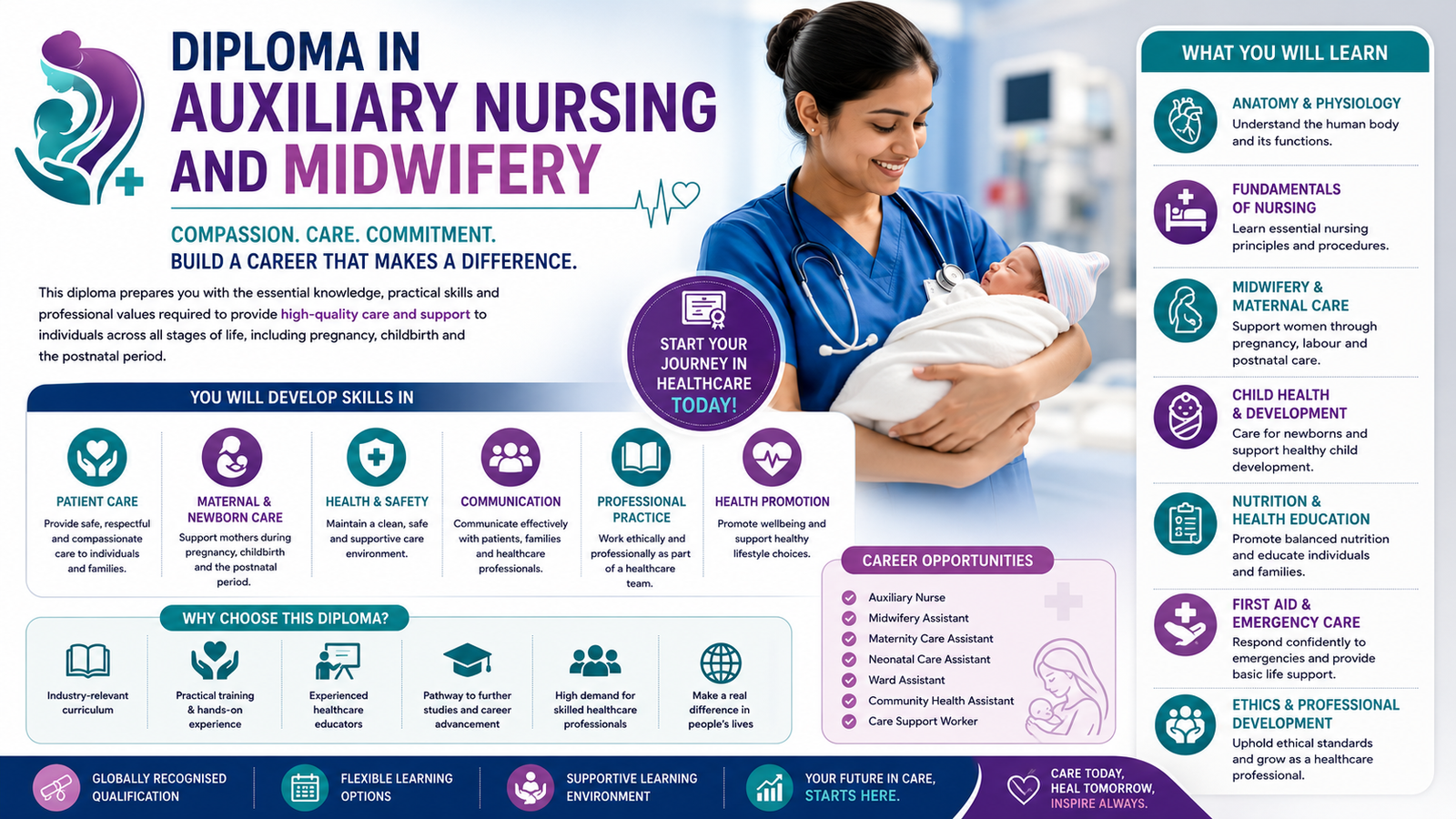
The Diploma in Auxiliary Nursing and Midwifery (Level 3) is a comprehensive vocational qualification that prepares learners to embark on a rewarding career in the healthcare sector. The programme focuses on developing essential nursing and midwifery skills, enabling students to provide compassionate, safe, and effective care to patients across a variety of settings such as hospitals, community health centres, maternity units, and elderly care facilities.
Aligned with UK healthcare standards, this course blends theoretical knowledge with hands-on clinical experience. Students learn about human anatomy and physiology, infection prevention and control, maternal and child health, patient hygiene, basic pharmacology, and first aid. The curriculum also emphasises ethical practice, communication skills, teamwork, and the importance of empathy and cultural sensitivity in patient care.
Upon completion, graduates will possess the core competencies required to work as auxiliary nurses, healthcare assistants, or midwifery support workers. The course also lays a strong foundation for further study in nursing, midwifery, or public health, providing a clear progression route towards advanced qualifications in healthcare. This qualification equips learners to make a meaningful contribution to individual wellbeing and community health through professional and compassionate service.
This course is most suited to individuals who are at least 18 years old, aspiring to enter healthcare, especially nursing and midwifery, including young students, mature learners, and women from rural or underprivileged backgrounds aiming to contribute to community health.
Course Fee: £500
The course fee includes access to online learning materials, assessments, tutor support and the student learning portal.
Payment Options:
Please contact the admissions team for further information regarding payment arrangements.
Introduction to Nursing
This module introduces the fundamentals of nursing, covering its history, ethical principles, and essential practical skills. Learners explore the origins and evolution of nursing, professional values, and standards that guide care delivery. It builds a foundation in basic nursing tasks such as patient hygiene, safety, and comfort while emphasising empathy, communication, and ethical decision-making. By the end, students gain the core knowledge and attitudes necessary for effective, compassionate nursing practice.
Anatomy and Physiology
This module offers a detailed exploration of human anatomy and physiology, forming the scientific foundation for effective patient care. Students will study the structure and functions of the human body’s major systems, including the circulatory, respiratory, digestive, nervous, and reproductive systems. Emphasis is placed on understanding how these systems interact to maintain health and respond to illness. This knowledge equips learners with the essential insight needed to assess, support, and care for patients safely and effectively.
Microbiology and Infection Control
This module examines microorganisms and infection control principles vital to maintaining patient safety and public health. Learners explore different types of microorganisms, their modes of transmission, and the conditions that promote their growth. The module emphasises proper hygiene practices, sterilisation techniques, use of personal protective equipment (PPE), and waste disposal procedures. By mastering these concepts, students develop the skills to prevent healthcare-associated infections and uphold high standards of cleanliness in clinical environments.
Pharmacology
This module introduces the principles of pharmacology, focusing on how drugs interact with the human body to promote healing and relieve symptoms. Students learn about various drug classifications, mechanisms of action, dosage calculations, and safe methods of administration. Emphasis is placed on understanding side effects, contraindications, and the importance of accurate record-keeping. The module equips learners with the knowledge and responsibility required to support safe and effective medication management within healthcare settings.
Medical-Surgical Nursing
This module focuses on nursing care for patients undergoing surgical procedures and medical treatments, emphasising pre-operative, intra-operative, and post-operative care. Students learn to prepare patients physically and emotionally for surgery, assist during procedures, and provide effective post-surgical monitoring and wound care. The module also covers pain management, infection prevention, and patient education to support recovery. By the end, learners gain the skills and confidence to deliver safe, compassionate, and evidence-based care in surgical and medical settings.
Maternal and Child Health Nursing
This module concentrates on nursing care for mothers and children, covering all stages from prenatal to postnatal care. Learners explore topics such as maternal health, antenatal assessment, labour support, and new-born care. The module also addresses child growth, development, immunisation, and common paediatric illnesses. Emphasis is placed on promoting maternal wellbeing, safe childbirth practices, and effective communication with families. By completion, students will be equipped to provide holistic, compassionate, and family-centred care in maternal and child health settings.
The diploma aims to prepare students for further education and career progression within the healthcare sector. This includes opportunities for specialisation, advanced studies, and leadership roles in nursing and midwifery.
The Diploma in Auxiliary Nursing and Midwifery (Level 3) is a comprehensive vocational qualification that prepares learners to embark on a rewarding career in the healthcare sector. The programme focuses on developing essential nursing and midwifery skills, enabling students to provide compassionate, safe, and effective care to patients across a variety of settings such as hospitals, community health centres, maternity units, and elderly care facilities.
Aligned with UK healthcare standards, this course blends theoretical knowledge with hands-on clinical experience. Students learn about human anatomy and physiology, infection prevention and control, maternal and child health, patient hygiene, basic pharmacology, and first aid. The curriculum also emphasises ethical practice, communication skills, teamwork, and the importance of empathy and cultural sensitivity in patient care.
Upon completion, graduates will possess the core competencies required to work as auxiliary nurses, healthcare assistants, or midwifery support workers. The course also lays a strong foundation for further study in nursing, midwifery, or public health, providing a clear progression route towards advanced qualifications in healthcare. This qualification equips learners to make a meaningful contribution to individual wellbeing and community health through professional and compassionate service.
This course is most suited to individuals who are at least 18 years old, aspiring to enter healthcare, especially nursing and midwifery, including young students, mature learners, and women from rural or underprivileged backgrounds aiming to contribute to community health.
Course Fee: £500
The course fee includes access to online learning materials, assessments, tutor support and the student learning portal.
Payment Options:
Please contact the admissions team for further information regarding payment arrangements.
Introduction to Nursing
This module introduces the fundamentals of nursing, covering its history, ethical principles, and essential practical skills. Learners explore the origins and evolution of nursing, professional values, and standards that guide care delivery. It builds a foundation in basic nursing tasks such as patient hygiene, safety, and comfort while emphasising empathy, communication, and ethical decision-making. By the end, students gain the core knowledge and attitudes necessary for effective, compassionate nursing practice.
Anatomy and Physiology
This module offers a detailed exploration of human anatomy and physiology, forming the scientific foundation for effective patient care. Students will study the structure and functions of the human body’s major systems, including the circulatory, respiratory, digestive, nervous, and reproductive systems. Emphasis is placed on understanding how these systems interact to maintain health and respond to illness. This knowledge equips learners with the essential insight needed to assess, support, and care for patients safely and effectively.
Microbiology and Infection Control
This module examines microorganisms and infection control principles vital to maintaining patient safety and public health. Learners explore different types of microorganisms, their modes of transmission, and the conditions that promote their growth. The module emphasises proper hygiene practices, sterilisation techniques, use of personal protective equipment (PPE), and waste disposal procedures. By mastering these concepts, students develop the skills to prevent healthcare-associated infections and uphold high standards of cleanliness in clinical environments.
Pharmacology
This module introduces the principles of pharmacology, focusing on how drugs interact with the human body to promote healing and relieve symptoms. Students learn about various drug classifications, mechanisms of action, dosage calculations, and safe methods of administration. Emphasis is placed on understanding side effects, contraindications, and the importance of accurate record-keeping. The module equips learners with the knowledge and responsibility required to support safe and effective medication management within healthcare settings.
Medical-Surgical Nursing
This module focuses on nursing care for patients undergoing surgical procedures and medical treatments, emphasising pre-operative, intra-operative, and post-operative care. Students learn to prepare patients physically and emotionally for surgery, assist during procedures, and provide effective post-surgical monitoring and wound care. The module also covers pain management, infection prevention, and patient education to support recovery. By the end, learners gain the skills and confidence to deliver safe, compassionate, and evidence-based care in surgical and medical settings.
Maternal and Child Health Nursing
This module concentrates on nursing care for mothers and children, covering all stages from prenatal to postnatal care. Learners explore topics such as maternal health, antenatal assessment, labour support, and new-born care. The module also addresses child growth, development, immunisation, and common paediatric illnesses. Emphasis is placed on promoting maternal wellbeing, safe childbirth practices, and effective communication with families. By completion, students will be equipped to provide holistic, compassionate, and family-centred care in maternal and child health settings.
The diploma aims to prepare students for further education and career progression within the healthcare sector. This includes opportunities for specialisation, advanced studies, and leadership roles in nursing and midwifery.
Want to receive push notifications for all major on-site activities?