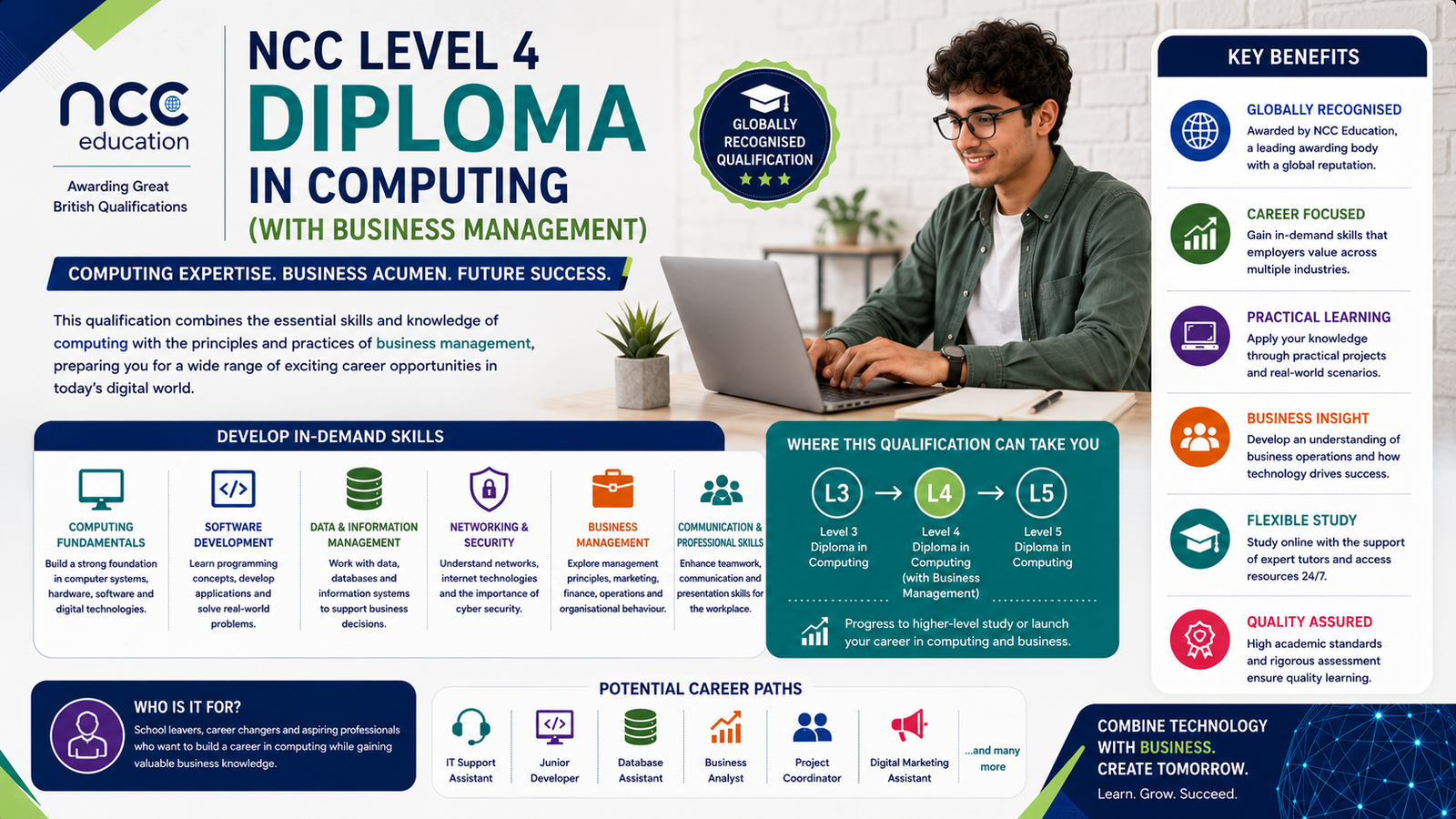
The NCC Education Level 4 Diploma in Computing (with Business Management) (L4DC BM) is designed to develop the academic, technical and practical knowledge required for progression within computing and IT.
The programme covers key areas including algorithms and mathematical concepts, computer networks, computer systems, databases, front-end web development, object-oriented systems analysis and design, software engineering and object-oriented programming. Learners develop both theoretical understanding and practical computing skills that can support further study and employment within the technology sector.
Applicants may enter the qualification through one of the following routes:
Course Fee: £4,500
The course fee includes access to online learning materials, assessments, tutor support and the student learning portal.
Payment Options:
Please contact the admissions team for further information regarding payment arrangements.
Students must complete the 4 core units, 3 specialist units and 1 elective unit
Core units
Computer Networks
This module introduces the fundamentals of network design, configuration, and management. Learners study network architectures, protocols, and security principles, gaining practical experience in setting up and maintaining networks. It equips students with the technical skills to understand data communication, troubleshoot connectivity issues, and support the infrastructure needs of modern business environments.
Computer Systems
The Computer Systems module explores the architecture, components, and functionality of computer systems. Learners study hardware, operating systems, and system software, understanding how these elements interact to perform computing tasks. The module provides practical knowledge in system configuration, maintenance, and optimisation, preparing students for roles in technical support and IT systems management.
Databases
This module covers the principles of database design, development, and management. Learners gain practical skills in SQL programming, data modelling, and normalisation, enabling them to design efficient and reliable data systems. The module highlights the role of databases in supporting business operations and decision-making through effective data storage and retrieval.
Front End Web Development
The Front-End Web Development module teaches learners to create interactive, responsive websites using HTML, CSS, and JavaScript. Students learn web design principles, usability, and accessibility while developing real-world web projects. The module builds creative and technical skills essential for entry-level roles in web design, digital marketing, and software development.
Mandatory Specialist Units
eBusiness
This module explores how organisations use digital technologies and eCommerce platforms to operate effectively in the modern marketplace. Learners examine online business models, digital marketing strategies, and emerging technologies. The module focuses on integrating IT solutions to improve customer engagement, efficiency, and competitiveness in the global business environment.
Essentials of Management
The Essentials of Management module introduces the core functions of management, including planning, organising, leading, and controlling. Learners study decision-making, goal setting, and performance management, gaining insights into effective team leadership and organisational success. The module builds foundational managerial skills for future business and IT leadership roles.
Understanding Business Organisations
This module provides an overview of business structures, objectives, and functions. Learners explore how organisations operate in changing environments and how internal and external factors influence performance. The module enhances understanding of organisational behaviour, strategy, and management principles, preparing students for roles in business operations and administration.
Elective Units – One
Algorithms and Mathematical Concepts for Computing
This module introduces key mathematical and algorithmic principles used in computing. Learners study logic, algebra, and problem-solving techniques to design efficient algorithms. The module strengthens analytical and computational skills essential for programming, system development, and data processing in both business and IT contexts.
Designing and Developing Object-Oriented Computer Programmes
The Designing and Developing Object-Oriented Computer Programmes module teaches the fundamentals of object-oriented programming (OOP) using languages such as Python or Java. Learners apply principles like inheritance and encapsulation to create functional software applications. The module develops practical coding and problem-solving skills relevant to modern software development.
Software Engineering
The Software Engineering module explores the software development lifecycle, from analysis and design to implementation and testing. Learners study methodologies such as Agile and Waterfall, focusing on quality assurance and project management. The module equips students with practical skills to design and deliver reliable, user-focused software systems.
Students can progress to the Level 5 Diploma in Computing (with Business Management) or Level 5 Diploma in Computing (with Cyber Security), both equivalent to Year 2 of a UK bachelor’s degree. Alternatively, students may apply directly to Year 2 of a related university degree programme.
The NCC Education Level 4 Diploma in Computing (with Business Management) (L4DC BM) is designed to develop the academic, technical and practical knowledge required for progression within computing and IT.
The programme covers key areas including algorithms and mathematical concepts, computer networks, computer systems, databases, front-end web development, object-oriented systems analysis and design, software engineering and object-oriented programming. Learners develop both theoretical understanding and practical computing skills that can support further study and employment within the technology sector.
Applicants may enter the qualification through one of the following routes:
Course Fee: £4,500
The course fee includes access to online learning materials, assessments, tutor support and the student learning portal.
Payment Options:
Please contact the admissions team for further information regarding payment arrangements.
Students must complete the 4 core units, 3 specialist units and 1 elective unit
Core units
Computer Networks
This module introduces the fundamentals of network design, configuration, and management. Learners study network architectures, protocols, and security principles, gaining practical experience in setting up and maintaining networks. It equips students with the technical skills to understand data communication, troubleshoot connectivity issues, and support the infrastructure needs of modern business environments.
Computer Systems
The Computer Systems module explores the architecture, components, and functionality of computer systems. Learners study hardware, operating systems, and system software, understanding how these elements interact to perform computing tasks. The module provides practical knowledge in system configuration, maintenance, and optimisation, preparing students for roles in technical support and IT systems management.
Databases
This module covers the principles of database design, development, and management. Learners gain practical skills in SQL programming, data modelling, and normalisation, enabling them to design efficient and reliable data systems. The module highlights the role of databases in supporting business operations and decision-making through effective data storage and retrieval.
Front End Web Development
The Front-End Web Development module teaches learners to create interactive, responsive websites using HTML, CSS, and JavaScript. Students learn web design principles, usability, and accessibility while developing real-world web projects. The module builds creative and technical skills essential for entry-level roles in web design, digital marketing, and software development.
Mandatory Specialist Units
eBusiness
This module explores how organisations use digital technologies and eCommerce platforms to operate effectively in the modern marketplace. Learners examine online business models, digital marketing strategies, and emerging technologies. The module focuses on integrating IT solutions to improve customer engagement, efficiency, and competitiveness in the global business environment.
Essentials of Management
The Essentials of Management module introduces the core functions of management, including planning, organising, leading, and controlling. Learners study decision-making, goal setting, and performance management, gaining insights into effective team leadership and organisational success. The module builds foundational managerial skills for future business and IT leadership roles.
Understanding Business Organisations
This module provides an overview of business structures, objectives, and functions. Learners explore how organisations operate in changing environments and how internal and external factors influence performance. The module enhances understanding of organisational behaviour, strategy, and management principles, preparing students for roles in business operations and administration.
Elective Units – One
Algorithms and Mathematical Concepts for Computing
This module introduces key mathematical and algorithmic principles used in computing. Learners study logic, algebra, and problem-solving techniques to design efficient algorithms. The module strengthens analytical and computational skills essential for programming, system development, and data processing in both business and IT contexts.
Designing and Developing Object-Oriented Computer Programmes
The Designing and Developing Object-Oriented Computer Programmes module teaches the fundamentals of object-oriented programming (OOP) using languages such as Python or Java. Learners apply principles like inheritance and encapsulation to create functional software applications. The module develops practical coding and problem-solving skills relevant to modern software development.
Software Engineering
The Software Engineering module explores the software development lifecycle, from analysis and design to implementation and testing. Learners study methodologies such as Agile and Waterfall, focusing on quality assurance and project management. The module equips students with practical skills to design and deliver reliable, user-focused software systems.
Students can progress to the Level 5 Diploma in Computing (with Business Management) or Level 5 Diploma in Computing (with Cyber Security), both equivalent to Year 2 of a UK bachelor’s degree. Alternatively, students may apply directly to Year 2 of a related university degree programme.
Want to receive push notifications for all major on-site activities?